Sunday, March 13, 2016

Not a roadie, not a mountain biker, just a cyclist.

Being that I am not looking, it becomes quite alright that I can't seem to find a real place in the cycling world within which to be compartmentalized.  Sure, I spend lots of time riding on dirt as well as logging plenty of road miles throughout the year, but there seems to be a lack of people to ride with considering the fact that I refuse to choose purely one riding style over the other while often incorporate the two in single rides.  Though the gravel/adventure bike scene has been the hottest thing to hit the market as of late and helps to slightly blur the lines between off vs on road cycling, there still seems to be a road/mountain biker dichotomy that splits the cycling world like a razor blade.  Take your pick; Peleton or Dirt Rag magazine, chamois or shorts, SPD cleats/shoes or platform pedals.  There is very much a black and white, one vs the other mentality that plagues the industry and only perpetuates the division between what at the end of the day are often like minded individuals.  Many of us clearly enjoy riding bicycles, being outdoors and enjoying the wonderful virtues of nature while appreciating high quality things in life such as good food, coffee and beer/wine.  So what is it about a simple thing such as big vs small tires that has us forming cliques, stigmas and often deliberate avoidance and or omission of one an other's presence?


Above is Pauline ferrand-prévot (center), the first woman to hold the road,
 mountain and cyclocross world championships all at one time. 

You ride a bike? Me too..


After having worked in a bicycle shop for the last two months (a very down to earth one mind you), I have seen self proclaimed cyclists of virtually every orientation come through and spread their wings.  From the uber hip, fashionable (?), fixed gear riding youngsters to the snobby, everything-retro-is-better proselytizing grouch and the conversely (and sometimes not so much) well financed, ultra high tech loving road and mountain cyclists, I have watched as they come, spoken their language, and gone.  Bits of dialogue I pick up on range from an absolute religious like worship for tech and new gear, to seemingly rare utterances of praise for the joy the act of cycling in and of itself.  Whispers of things that are undoubtedly indicative of a cyclists attempt at identifying with fill-in-the-blank genre become all to solidified after correlating the talk with the walk.  There is a style and swagger behind the various cycling sub-genres that have genius marketing schemes capitalizing on and further compounding the sub-culture mentality within cycling.  Books such as Bicycle Tribes have come to identify, but (inadvertently?) perpetuate the dissemination of cyclist sects within which one can relate to, and then ultimately become assimilated within.  Conforming to social, cycling, eating and drinking habits, the cyclist who identifies her/himself as a one particular walk of rider vs another has not only hindered their ability to congregate within other cyclists, but literally and figuratively confines their cycling style and riding boundaries.  There are certain unspoken rules and style dos and donts within the cycling community that very much compose the core backbone of what it means to be a roadie or a Mountain bike.  It is the dissolution of such dichotomies that interest me as a cyclist, mechanic and writer.

A cyclist stands by her commuter; a mountain bike equipped with racks for toting, drop bars 
for speed and big, plush tires for comfort. (Image courtesy of http://bikecommutechallenge.com/)


Walking the walk


It doesn't take much to spread the good vibes of cyclist inclusion.  Go out on that all day ride with the "roadies" and get your ass kicked a bit while showing them how much fun you are able to have on your not so pure bred road bike.  You could always invite your "fixie only" riding friend to join you on a slightly more adventurous ride to broaden the horizons.  What about taking that "gravel grinder" bike of yours out on some rougher trails and splicing in some love for the die hard mountain bikers?  We all need people to come in and shake things up a bit, blending good styles and aspects of cycling from all genres.  If riding a single speed road bike while wearing tall socks with SPD (mountain cycling) shoes, a messenger bag, lycra shorts and a skateboarding helmet is your thing; please, by all means.  As half of the struggle here is a style war, the further we remove ourselves from various cliques the more we can allow ourselves to be where we want, riding how we really want to with a hopefully increasing number of like minded individuals.

Sunday, February 21, 2016

Steel bicycle frames: the pros, the cons, and why I continue to ride them

In the bicycle world, the steel vs fill-in-the-blank frame material conversation is so seemingly prevalent that one can easily wonder whether or not a visit to the local bike shop will end in a vehement, single sided argument with both sides walking away equally bitter.  It's an all too often classic fight of the ages; the iconoclast, vintage thumping retro-grouch vs the space age, "latest and greatest everything is better" proselytizing contrarian.  Though the above mentioned observation may seem somewhat black and white, it unfortunately proves to be the case in most instances.  Seldom do I experience truly open ended conversations encompassing unbiased views pertaining to "old vs new" that encourage a rational middle ground.  For this very reason I desire to open up a can of worms that seems to stand as the mother-of-all conversational focal points within the bicycling community while doing so with the most carefully considered and all encompassing approach possible.

All is compromise


When selecting tubing material for your bicycle there is without question a large handful of variables that must be considered: the more important being frame weight, handling characteristics, load capacity, terrain application, longevity and ease of repair.  What it really boils down to is what you plan on doing with your bike: road racing, loaded touring, trail riding, track racing, urban commuting, cyclocross, ect.  The desired application should dictate initial considerations followed by aspects of lesser concern.  The next focal point for anyone without bottomless pockets of cash would logically be the cost-benefit-ratio.  An acquisition that incorporates palatable levels of reliability, cost effectiveness and performance is what I feel most cyclists look for and will serve as an adequate template for what follows.  Steel, aluminum, titanium and carbon fiber compose the landscape of modern frame building material and vary highly in cost, weight, ultimate tensile strength, fatigue life, ease of working (welding, bending, heat treatment, ect) and handling characteristics.  Diving into metallurgic properties can in and of itself warrant for a lengthy write up that I hope to avoid within this post while conversely touching on some of the basic aspects that give steel the characteristics that have contributed to a somewhat cult like obsession for many.  Hearing catchy phrases thrown around such as "steel is real" and "hand built steel is the best" as often as I do has only further solidified the fact that though steel is an outstanding material choice for many, a tremendous amount of it's momentum in re-emerging as a high end bicycle frame material is partially based on marketing capitalization and myth surrounding racing legends as well as custom frame builders.  The reality is that steel bicycle frames can be made as either outstanding tools that endure decades of abuse, or as poorly fabricated, incorrectly purposed junkers that suffer from terrible handling characteristics and low fatigue/tensile life expectancy.

Though slightly dated, the Massachusetts Institute of Technology publication
"Bicycle Science" has let the numbers do the talking with this informative
comparrison chart.  Not alot has changed with steel, aluminum, titanium and
carbon composits over the years.


 Economic material, economic results


Having worked as a professional metal fabricator for the last 4 years I have been afforded the luxury of having first hand experience with working steel of all sorts. From stainless and chromoly alloys to hardened tool and hot/cold rolled mild steel, I have spent countless hours bending, machining, plasma cuing, welding, rolling, hydraulically forming, grinding, polishing, sanding and tumbling steel in most ways imaginable. I have watched very low quality steel take tremendous abuse over and over again without failing, and conversely watched things like chromoly fail from what would seem like normal use under conditions that in theory would not exceed it's fatigue or ultimate tensile threshold. The reality of the matter is that not all steels are extruded, bent/rolled, forged/cast or welded and heat treated equally. It is my opinion that these facets account for more of the wild card variables that give rise to frame failure out on the road than say the bicycle simply being "cheap".  Having owned everything from hand built fixed gear and mountain bike frames to mass produced counterparts of both modern and vintage makes, the overall take away from years of riding both ends of the spectrum is that products of comparable quality can be found in both small-batch made bespoke bicycles as well as japanese/taiwanese mass produced frame sets.  Though this is a generally accurate rule of thumb, it is by no means always the case.  It's not so much that your fill-in-the-blank custom frame builder of choice has a mythical, Midas-like touch that renders their work impervious to failure as it is that small batched, hand worked, quality controlled production tends to be more conducive to consistency than say mega factories with super large batches of mass produced frames. 

Kusaka San of the now defunct Vivalo Bicycles tacks an
aligned bicycle frame.  I owned and heavily rode a bicycle
 built by this man that was nothing short of spectacular.


 Why I choose steel


I often times liken the act of purchasing/riding a steel bicycle to that of owning a Toyota as opposed to a Porsche. Though the Porsche (being super thin walled, light weight aluminum and carbon fiber frames) will get you from point A to B (usually), the likelihood of being able to do so consistently, for long periods of time without experiencing issues along the way is not so high. The Toyota (being steel bicycle frames) is by most standards an inexpensive vehicle to own that will typically last for ages without showing many signs of problem. Being that parts are so readily available, in more cases than not it is substantially easier and more affordable to service when time comes. Though the Toyota will generally be slightly heavier, slower, and less sporty in appearance, it's utilitarian purpose as a quality vehicle that excels at many things, while failing to be perfect at any one, pays dividends for the not so purely race oriented consumer. The ultimate differentiating factor between the Porsche (similar makes as well) and Toyota is that the Porsche is a sport machine being sold to typically non-sporting consumers, whereas the Toyota was built more so with comfort, ease of transport and reliability in mind. Just as the automotive industry benefits massively from counter intuitive marketing schemes does the ever lucrative bicycle industry seek to do the same by selling the fastest, lightest and most technologically advanced product to a consumer who does not only lack a need for a such a specialized synthesis, but would more than likely otherwise lack the inclination to make such a purchase all together. Typically the speed of these race machines come at the cost of harsher geometry, super stiff riding characteristics (the previous not pertaining to suspended mountain bike frames), super high tolerance component requirements, seriously compromised fatigue life and greater likelihood of catastrophic failure during a crash.  Some of these mega bicycle manufacturing think tanks have not only insulted our intelligence as consumers by attempting to sell us fragile products with short life expectancy, but often time locked us into product marriage with new and obscure component standards that leave us going back to the same few, if not singular, component manufacturer(s) for their usually expensive replacement parts. The beauty with the steel bicycle (think Toyota again) is that for the most part, product support, interchangeability and universal standardization has opened up the doors to inexpensive repair, DIY modification and easier home mechanic serviceability.


My old steel workhorse (mass produced 1989 Diamondback Apex) that has 
endured innumerable loaded commutes, city bus rides,
truck bed transporting, off road rides, pot hole hits, bicycle rack smacks, ect..  
Though the steel tubing is slightly thicker than I would normally prefer,
the handling characteristics are outstanding with the bicycle loaded down.

Racing requires race machines


Those of you who have read even a few of my blog posts will have come to the realization that I stand firm in my decision that we as "serious" cyclists have to level with ourselves in acknowledging the fact that most of us simply are not, and never will be racers.  It's something that contrary to heavy marketing exposure, we as consumers must come to terms with if we are to establish rational purchasing habits.

  Hypothetically speaking, if I were to set out on a mission to seek contention in professional racing I would certainly look toward lighter, stiffer and more aerodynamic bicycle materials such as aluminum and titanium. When longevity and previously mentioned considerations cease to be critical, the text above understandably looses most traction. Winning races has not, and never will be about mounting your bike and hoping that it will perform daily, over and over again with minimal issue. The main consideration in racing is that the bicycle can complete it's task well enough that the race(s?) has/have been completed without any mechanical failures. When sponsors such as component manufacturers and frame constructors facilitate racer's sporting endeavors, all necessity for long term durability and strength become sacrificed at the expense of speed in every dimension that it entails. For applications such as these, choosing steel begins to seem like less and less like a logical decision as carbon fiber immediately comes to mind. Though carbon fiber often fails catastrophically during races, it is typically negated as a concern due to the consistent replacement of frame sets, wheels and all carbon cockpit components donated by sponsors. The disposable factor is more or less irrelevant for these high echelon cycling teams and riders who are the beneficiaries of a never ending flow of replacement bits.  For those of us who are not so generously taken care of, seeing our dollar go a long way is simply a must in a world where it is becoming incrasingly depreciated and harder to come by.  It is for these very reasons that I see steel as a frame material has making the most sense for my riding habits and mentality.  Though it might not be for everyone, it is certainly one that almost everyone can afford  to own and replace if damaged or stolen.

Monday, January 25, 2016

I am now a "Happy Bikes" family member

I am now officially part of Stevie's Happy Bikes crew in Corralles, New Mexico and will be helping out with mechanic/sales work a few days out of the week when it starts to warm up here.  I never seriously considered working for a bike shop until recently when I became more acquainted with Stevie and his way of work.  The shop that he runs outside of Albuquerque is my cup of  tea being that second hand bikes and consignments are emphasized far more than pushing new bike sale quotas and super high end componentry.  The yard is littered with vintage road, mountain and cruiser bikes spanning many decades evoking the sense of orphan children looking for TLC and good homes.  Though they do sell new bicycles and components, the central focal point is on practical bicycles that will regularly be ridden as opposed to 4-5 $ digit race machines.  The fit seems great for me and will certainly be a positive environment for me to spread my wings, giving attention to the blue collar side of the spectrum and helping promote cycling for all, not just the affluent. 


Friday, January 15, 2016

How many bikes are enough?


With the ability to choose from road: commuter, adventure, gravel, touring, cyclocross, cross country, enduro and downhill bicycles, the options seem myriad and leave the doors open to one of the more obvious questions facing cyclists; how many bikes are enough?  To begin answering this question would be to first really break down the various styles of bikes offered today.  From featherweight, aerodynamic road bikes to 5"+ travel suspended mountain bikes, we must figure out what we are trying to achieve, how often we are trying to achieve it and determine what constitutes a reasonable amount of money to spend in the process.  A logical follow up question would be to ask how many bicycles can fill multiple roles at one time without sacrificing to much in one realm or another.  The balance of compromise seems to be all to prevalent in the world of cycling; particularly pertaining to the rider seeking "jack of all trades" style bikes.


Speed and light weight vs comfort and durability


Two of the biggest aspects obsessed over in cycling are light weight products coupled with ultimate speed.  The desire to go faster for longer periods of time is a goal that most cyclists strive to achieve at one point or another and often overshadows the cost/benefit ratio of such an equation.  To get something for nothing is simply never the case as light weight frames and componentry will always come at an inversely proportional cost of strength and durability.  A thoroughbred road race machine for example will exhibit characteristics that lend itself to lightning fast hill climbs and wind tunnel test worthy times on the tarmac but will lack when the going gets rough and terrain becomes somewhat bumpy and uneven.  Someone once said that "to overspecialize is to breed in weakness" and could easily have been speaking particularly about the bicycle when making this assertion.  It is to the degree that one aspect becomes more and more the focal point of purpose that other aspects become further from grasp.  If your goal is to have the fastest road bicycle possible you will find that it is best to operate such a machine within the particular parameters it was designed around.  Pushing to far into the opposite end of the operational spectrum will deliver a sometimes painful and expensive message.  

Gauge your riding style well and try
 not to be like this person...

When it comes to bridging the gap between bicycle genres you indeed make trade offs.  A more sturdy aluminium or steel frame will cost you extra weight and thus be slower but will begin to pay dividends when it comes to longevity and overall comfort.  The aggressive geometry of a race steed will  pay a toll on you physiologically as a hunched over, aerodynamic position taxes the body if held for long periods of time on a regular basis.  Conversely, too relaxed of geometry will not lend itself well to consistent lengths of power output and will in turn also be sluggish in the corners. Figuring out what importance one facet or the other plays in your cycling experience will be completely personal and should be ultimately determined by your intentions.  An important question to ask at this point is whether or not you are really a full-tilt professional looking for marginal weight savings and aerodynamics geared toward every particular genre of riding or someone who wants to get the most out of their bicycle purchases.

Dynamic and enduring


These two words above best epitomize a well spent dollar for non-millionaire individuals lacking bottomless pockets of cash.  To acquire something that does a few, or possibly many jobs well and is simultaneously enduring constitutes true efficacy.  If you are the type of cyclist that likes to go beyond a purely road or mountain oriented ride in a more recreational inclined fashion, the words in the header above will in time present themselves to be just as necessary as desirable.  By bridging the gap between some of the never ending bicycle genres you can do some serious downsizing to your current and/or hypothetical bicycle stable while conversely upgrading your wallet in the process.  The question once again arises; what do you want to do with your bicycle(s)?  Perhaps you like road riding but also enjoy good stints of back road gravel trekking.  Or maybe you are into fast paced boulder ridden trail riding and at the same time enjoy less gnarly fire road rides.  Do the previously mentioned riders really need two not so different yet equally expensive bikes to fill the void of two similarly related objectives?

The late Jobst Brandt (highly revered bicycle critic, 
mechanical engineer, author and avid cyclist) making easy
work of some dirt trails on his "road" bike.

Fewer bikes, less profitibility


 For the sake of length (i tend to carry on) subtle bicycle differences will be ignored in this particular post to try and stay on topic.  The main concern attempting to be expressed is an overabundance of bicycle consumption geared toward a market of  riders that lack the time or necessity to justify such niche orientated, overlapping bicycle purchases.  Cutting through the industry fluff in today's world is just as important as understanding the subtle intricacies that compose bicycle similarities and differences.  There is certainly more in common with a cross country and enduro bicycle than fill in the blank manufactures will lead you to believe, and for a very good reason at that.   The bicycle marketing think tanks that be will lead you to believe that you need one particular bicycle, for every possible riding scenario.  It is simply not lucrative for the mega bicycle conglomerates that dominate the market to sit back and watch as masses of riders downsize their purchasing habits with less frequency.  In order to prop up the bicycle industry such manufactures feed on current trends that exhibit even the slightest bit of traction.  If a slightly new wheel size for example (think 29'er in the mid 00's and 650b circa 2012)  proves itself in the world racing circuit battle ground, you better believe that every effort will be made to lead you into believing that your previous setup is now obsolete.  The objective of never ending bicycle sales coupled with race oriented, weight and speed obsessed cyclists will continue to pave the way for more and more styles of bicycles to fill more and more supposedly niche riding.  It is up to us a cyclists to cast a voice using our most valuable tool being our dollar.  Our purchasing power tells such companies and industry annalists that we are indeed intelligent and discerning cyclists.  If we continue to feed into the previously mentioned propaganda we will certainly perpetuate the train of planned obsolescence that has already gained such momentum.  Perhaps the next time you watch Alberto Contador (6 time grand tour winning road cyclist) climb the Pyrenees, or Julien Absalon (6 time world cup winning mountain biker) descend rock gardens in Windham, ask yourself if its really the $9,000, brand new super light bicycle in between their legs that enables them to do what it is they do with such grace, or perhaps more so their fitness, skill and accurate bicycle fitment. 


Saturday, December 19, 2015

The bicycle is about to get a lot more important

It's close now to Christmas of 2015 and we find ourselves in one of the most slippery and tricky socioeconomic and geopolitical settings to have ever been seen.  Here in the United States we see all the earmarks of economic calamity abundantly and emperically observable.  We see monetary bubbles of every variety on the brink of popping.  Un/under employment numbers have been massaged to something around 5% when the reality is something closer to 20-25%.  Not only GDP (gross domestic production) but total national GDP is slumping in negative figures.  Foreign relations are precarious at best as the U.S. actively engages in an asymmetrical, new cold war with Russia.  OPEC oil producing countries are pumping a massive overabundance of crude into the west and over saturating a market that has seen a virtual standstill in the industrial  manufacturing sector ($1.75/gallon - 35$/barrel oil looks good but is truly indicative of quite the contrary).  The International monetary fund has now included the Chinese Yuan in its reserve currency basket and will subsequently lead to innumerable U.S. treasury bonds bouncing back to the states to further exemplify the icing on the cake effect of our economic depression.  Couple all this with the fact that the Federal Reserve Bank of New York (IE: our big dollar printing press) has just announced a .25% hike in interest rates for 2016 with the promise of 4 more hikes before 2017.  So what exactly does this mean for us cyclists?


A lone cyclist rides amidst a sea of motorists;
a soon to be less familiar image.


The ultra high end bicycle market


Over the course of the post 2008 to-big-to-fail banking fiasco we saw a slow, incremental rise in the interest of uber high end bicycles.  Bespoke and high end bicycles product saw some serious peaking as the Fed implemented Quantitative easing (ie: "economic stimulus" via monthly heroine like monetary injections into wall street) as we seem bound for the continuation of exponential bicycle market growth.  The hand built bicycle industry made monumental leaps and gained locomotive-like inertia here in the United States as well as other high-median household income countries.  The ability to acquire such a bicycle was not to far from reality for even those who did not rake in a six figure annual income like some.  Loans became more cheap and easy, housing  more affordable, jobs in theory stable with sentiment in the dollar looking beautiful as ever.  Faulty a barometer though it may be, the stock markets rose to all time highs last year as we were sold the illusion that things are not only fine but getting substantially better.  Consumer confidence seemingly rose in direct proportion and gave rise to a wave of "disposable income" spending which in turn meant serious growth for the up scale bicycle industry with its renewed interest over the recent years.  The problem is that all of this was and still is predicated on a hollow/worthless  U.S. dollar (a fundamentally broken monetary system), endless money printing, loan handouts to anyone breathing.   There is not much more than stilts left propping up our hyper fragile world economy as it is only a matter of time before things begin to break down in terms of our standards of living and ideas of wholesomeness.


Here we have some well composed imagery curtosy
 of the fashion/lifestyle giant Rapha; someone other
 than you and getting what appears to be
their $6,000 ride on.

Fast forward to December 2015 as we stand at the tip of the iceberg in terms of our plateau.  Some big changes in consumer tendencies are something that all bicycle manufacturers will be faced with in the coming years.  As individuals and families alike make the shift in standards of living to ride out the wake of the economic tide, the bicycle industry will in turn be forced to make adjustments accordingly.  The marketing of do-it-all bicycles will be ever pressed to retain sales for those who no longer have the financial means to facilitate a 5+ stable of mid-high end bicycles.  More low end economic adaptations of preexisting designs will become more a thing of the future.  The push of the "hybrid" bicycle will become once again prevalent but of course packaged with a nice new box and image to sell to us as we saw with the all road/adventure/cyclocross/gravel bicycle (more or less synonymous terms at this point) trend of 2014-2015.  Sure, there will be a market for the ultra niche and uber expensive custom bicycle and products in the future, but it will be particularly the companies and builders who make efforts to adapt to changing times and bring to the table more high quality, versatile, entry to mid range offerings that I believe will thrive in economic hardship.  Said companies and builders who can realistically cater more to the lower and middle class will stay afloat while ultra bougie companies will slowly price themselves out of the market in a stagnant, insolvent and debt ridden economy.  Look for manufactures to push more commuter oriented bicycle designs being that bicycle commuting is about to take a hike in popularity, be it voluntary or not.


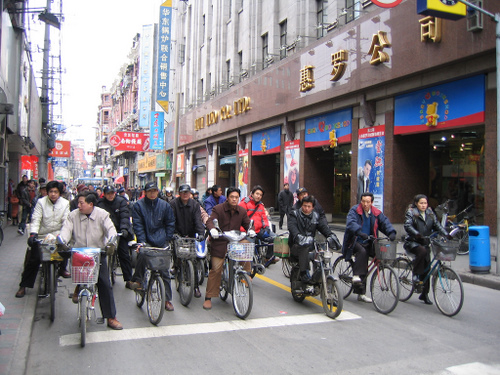
Commuters ride en mass somewhere in China.
Transportation oriented riding greatly outweighs
 recreational cycling for sport in most Asian
countries.


What's old can be new again


So here you are, stacked up with more than enough bicycles to ride out the next few lifetimes worth of cycling adventure.  The real question at this point seems to be weather or not it is A: economically plausible to continue updating the bicycle stable in a similarly mentioned fashion, or B: worth doing in the first place even if funds permitted.  Evident as a reoccurring theme in past blog posts, an emphasis on rebuilding and repurposing preexisting bicycle frames and componentry is certainly part of my rhetoric here. In a time when every dollar begins to matter more and more, is it not logical to try to squeeze every last gram of value out of your hard earned, not so easy to come by income?  Most of us avid bike lovers could quite literally afford to take that old steed out of the garage and make attempts to breathe new life into it.  For the sake of our wallets, our unbelievably deteriorating planet (your and my home) and the integrity of our sanity in a bike world of year in/year out planned obsolescence; taking the foot off the gas in terms of expensive, lifestyle statement forward purchasing just might make the difference in a world of such overabundance and throwaway culture.


An exceptionally modest bicycle workshop
in Theran, Iran.   Its hard not to admire such
resourcefulness exhibited in far less affluent settings.

Friday, December 11, 2015

Riding just to ride

You're all set, firmly mounted to your trusty steed and ready for the roads ahead.  Air pressure: check, saddle height: check, tools/snacks/water: check.  You're looking around now, its mid day and your alone with no agenda ahead of you other than to just ride somewhere.  No one thing dictates how, where or why you will go as you will.  You know its time now yet you hesitate.  Its just you and the path ahead, wherever that may be.  But where?

Aimlessly you ride with no end in sight; no particular destination or time to beat.  Strava off, power meter off and phone on silent.  Its strange; you cant seem to remember the last time this happened.  Really?  A ride for the sake of a ride?  Its been to long but that's ok because you're here now.

Inclination gravitates toward a steady pace as you begin riding along at a decent clip.  You're feeling a good tempo and it begins to take over.  Similar sights surround you as you pass familiar places while something catches your eye.  Its a new road, or at least to you it is.  As youto  decide make that turn into the unknown you are presented with a gentle grade that soon tapers into a daunting climb. You can only know what to expect so far as the eye can see; but its a windy one and your not so sure what you got yourself into here.  You're deep into this monument and somethings telling you to continue on.  Its beautiful, the scenery that loomed under your nose as you passed by many a time without every taking the care to experience this new adventure.  The road climbs and its steeped with texture; new smells and sights flooding your senses.  The not so manacured quality of the gravel, the fluctuating nature of the climb, the over abundance of plantmatter: all these things going through your head as you move along.

The pedals continue to turn and you move along enjoying the view as it passes you by.  You're asking yourself what your doing.  No intervals or technical training here, just a beautiful ride; that's right. 

At this point something interesting begins to happen.  Instead of upping the pace you slow down and spin a higher cadence.  What's the hurry after all, you can take this as quickly or slowly as you want; no negative repercussion awaits you. 

So here you are now just pedaling along simply because you can, because it feels good.  You're heart rate has climbed in direct proportion to the grade of the path and your legs have come alive at this point as the lactate acid begin to do its thing.  You're entire body is at work now helping guide you up this trek.  Its gratifying yet paradoxical; working hard to go nowhere in particular, for no particular reason other than to just do it.  What's the end gain here?  Its not like your walking away with anything.  Or are you? 
 
You're pace begins to slow now and you can see that its almost over as quickly as it began.  Did you see it?  That pocket of wild mushrooms on the side of that tree halfway up the climb?  Did you feel it?  What you must have sworn was the coolest summer breeze to have ever graced your sweating body.  Did you smell it?  They were a varietal of wild flowers that only express their nature at such elevation.  It was the essence of your existence all at your fingertips.  It was yours for the taking and the beauty is that it didn't have to end with the bike ride.  It only seemed to have started here as you began to focus your efforts inward simply for the sake itself.  You tried to unplug so as to come back to a place of receptivity; a place where you could be alive for things as they were immediately happening as opposed to conceptualizing the unknown variables that might dictate the rest of your week. You turned down that road because you didn't know what to expect or where it would go.  It was one of the most symbolic and brave things you've done in a long while. 

It was beautiful, your journey into pure uncertainty.  Life exemplified simply through journey via landscape steeped in color and dimension; flavor of all variety.   You danced like you never quite had before in a  spontaneous and graceful child like fashion.  Will you take another turn like that sometime? 

I'm curious, aren't you?


Saturday, December 5, 2015

Is the "Adventure Bike" phenomenon a double edged sword?

For about 3 years now us cyclist consumers have seen a massive marketing shift toward a supposedly new breed of road(?) bicycle that has been branded under the title of gravel grinder, all road and adventure bicycle.  The identifying features of such bikes are taller bottom bracket heights, clearances for larger tires (typically up to 45mm), more lax geometries, more fork offset (rake) and the utilization of what some consider to be the more primitive of frame materials being aluminum, steel and sometimes titanium.  The reality of the matter seems to be that these new fill in the blank style do-it-all bicycles have more in common with our French/British cyclotouring and American mountain biking ancestry than any contemporary road bicycles and deserve close scrutiny as being legitimately new or groundbreaking for various reasons. When purchasing one of these new bikes we have to ask ourselves if we are truly the beneficiary of something that lends itself to rationalizing a purchase often well over the $2,000 "entry level" mark that quite possibly overlaps as a redundant purchase in our stable of bicycles.  Lets embellish the ups and downs, pros/cons and realities of these all to often differentiated sub genres of bicycles.


Exhibit A: Modern "adventure" bike.  You know this is a big deal when a company like Trek jumps on board.


Randonneur roots


Many of the quality bicycles of yesteryear would be of particular interest to the avid adventure oriented cyclist, particularly those of the late 1930's to the 1960's.  These bicycles were outstandingly diversified machines capable of being utilized on mixed terrain with comfort, speed, durability and load bearing in mind.  These bicycles were called cyclotouring or randonneur bicycles and filled a massive niche in the cycling industry during a time when longevity and versatility reigned supreme.  This lineage of primarily French, British, and Belgian heritage arguably helped pave the way for the modern mountain bike of today, but certainly acted as loose template for this "new" style of bicycle that is being investigated.  All the previously listed earmarks are here such as the wide clearances, more fork rake, tougher material selection and comfort oriented geometry and component selection.  Even the incorporation of bicycle specific methods of lighting are present.  So what gives?  Is this nu-adventure bicycle marketing just a gimmick to sell us yet another bike to serve yet another different job, or are we really looking at something special here that is really shaking the market up.  The answer is just as much yes as it is no.

Exhibit B: a well kept Rene Herse cyclotouring bicycle outfitted with all the usual goodies.

The future in the past


At this point we can clearly see that there is a cyclical trend occurring in the bicycle industry, and it seems indeed to be a healthy one that promotes the more spontaneous and uncalculated side of bicycle riding.  This new shift in design and marketing that is seeming to stitch up the split in the road vs mountain bike world has come at an important time for many who have fallen into the black and white scenario of picking either their "road" or "mountain" bicycle and going out for a ride accordingly.  Being able to mount your steed and take that turn from pavement onto that unknown gravel road or finally being able hold the confidence to ride that bit of windy single track all on the same ride has never been so close to being reality.  It's exactly this ability of such bicycles to dance around from one form of terrain to another that lends itself the new moniker of the "Adventure" or "All road" bike.  But we must acknowledge the fact that all of this has truly been done before though in a slightly different package, and that out there in the world is a multitude of forgotten bicycles that are more than capable of being sized up to the adventure oriented task of bicycle riding that your heart has been so desiring.  Coincidentally enough, that forgotten bicycle might be right under your nose in your own garage collecting dust behind the supposedly more noble steeds of today. 


Exhibit C: what would typically be considered a generic vintage mountain bike turned full tilt utility machine.


The touring and mountain bike


The 1970's through the 1990's was a breeding ground for what make some extremely fine candidates that are very much capable of filling the previously mentioned niche.  For just a song one can acquire a late 80's to mid 90's mountain bike frame for next to nothing and easily build it up to accommodate rides of all sort.  Virtually all frames of this vintage come standard with braze-ons for mounting rear, and sometimes front racks as well as having holes drilled for fenders.  By outfitting the bicycles with slightly smaller tires having tread to your liking (sub 1.95") and making handlebar changes or adjustments you can in no time set yourself up with a dynamic bicycle capable of handling most jobs throw it's way.  The same can be said for older touring bicycle frame sets.  Though not as wide they almost always have generous tire clearances and slightly more aggressive geometry for those looking for a more sporty, less off road oriented variant of "adventure" bike.  Compromise is inherently nature of the beast when it comes to jack of all trade bicycles like this and must be considered when buying or building up such a bike.  Should more robust but heavier steel tubing be used or perhaps lighter less impact resistant tube sets?  Should wider tires with slightly more knobby tread be used or a more narrow and slick tires; perhaps wide and semi slick?  Should I build a bike with 26" wheels for more strong, fatigue resistant and nimble ride characteristics or a 700c/29" wheeled setup for better rolling and stability characteristics?  Such questions can only be answered based on the desired applications and frequency of particular terrain encounters.  Will you see more paved and easy going gravel riding on your ventures or perhaps primarily rough trails mixed with lots of loose sections?  To attempt to perfectly bridge the gap is of course futile but indeed important in the quest to build or buy the most neatly tailored bicycle that suits your defined goals.