Thursday, May 4, 2017

Falling in love with "do it all" bikes

Thin walled steel frames, 700c wheels with 28c tires, narrow handlebars and racy geometry: this fragment about sums up the first 5 years of my cycling as well as a portion of the last 5.  In the pursuit to ride more rugged road and choose different lines throughout the city's inconsistency I began riding fat(er) tired bikes in 2013 and have been an avid all around cyclist ever since.  With a fondness for road, mountain, BMX and cyclocross I have become influenced by and incorporated a wide spectrum of cycling styles into my riding.  Being able to jump on a single bike and do most things was massively attractive to me in the quest to have more unhindered fun.  For some time now I have been infatuated with the idea of making the most out of bicycle builds by utilizing a jack of all trades style mentality; even while riding dedicated road or mountain bikes up until recently.  Simply put; to be capable of tackling a little bit of everything is what characterizes a well rounded bicycle in my eyes.  So here I am today, disenchanted almost entirely with the myriad bicycle genres that seem to do a great job of limiting our cycling experience by being so heavily refined.

You cant get something for nothing 


Road bikes are fun, fast, light weight and super nimble.  They can allow you to travel vast distances with relatively little effort and are great at what it is they are designed to do; ride well on solid road surfaces.  From super clean tarmac to ultra rough pave, the road bike has its place and has indeed proven itself time and time again by granting riders the ability to traverse great lengths quickly; but at a cost of course. The road bike boasts its short chain stays, narrow bars, aggressive geometry, high gearing, and ultra light weight with no attention paid to what it sacrifices in the process: durability, suspension, comfort, poor low speed handling and inadequate gearing for sustained hills are the first that come to mind.  Though the road bike is wonderful and important, it is certainly not for everyone in having its limits.

Four different ways of saying that these bikes are all more or less the same.
Drop bars, 700c wheels, similar tire sizes, brake hoods, high gearing for speed, and
thin walled carbon, aluminum or steel frames with very similar geometry.

Mountain bikes are conversely outstanding and fun while embodying the opposite end of the aforementioned spectrum.  Super relaxed geometry, suspension forks and shocks, mega beefy frame construction (usually), soft compound tires with super tall and widely spaced knobs and ultra wide handlebars dictate the rugged, "off road only" nature of the modern mountain bike.  Though very effective in its elements, such bikes lack massively the moment a ride hits hard packed surfaces or tarmac.

Compromise is seemingly non existent these days within bicycles genres, granting little in terms of diversification.  Very particular goals are met by honing in on very specific attributes that constitute these niches, constricting the consumer into the purchase of a dedicated one-trick-pony.

I wanted it all, but couldn't have it


You want speed; get a road bike.  You want to ride trail; get a suspension mountain bike.  You want to ride gravel and hard pack roads; get a cyclocross bike.  You want to move around fluidly in the urban landscape; get a hybrid/city bike.  These are just the vague big categories of bicycles that most fill in the blank bike shops will carry and try to sell you. Curious as to where this is supposed to leave you, me and the next person as we lead to believe that every one of us should own at least 4 bicycles for each individual cycling related task.  Can most of us even set aside enough time to ride these bikes in a way that truly rationalizes such mentality?  Is it really incomprehensible to try and incorporate a crossover into our riding habits so as to save time, resources and money?  The answer varies massively depending on who you ask.  Big box bike industry will sell you a new bike for every style of riding at every opportunity like a shark seeking blood in water.  Though it is indeed hard to reinvent the wheel, it is easy to reinvent image and redundancy.  Taking an old concept and wrapping it up in new clothing has ultimately been the monetary saving grace of the bicycle industry for what is in my opinion the entirety of the 2000's and prior.  To see it for what it is will simultaneously hear the silent alarm of B.S.

Here is a bike that can do a bit of everything.  All day comfort for mortals: check.  Sensible gearing for the steepness
 factor: check.  Big kushy tires for suspension and a wide footprint when the terrain gets loose: check.   
Racks to move something other than your body: Check.

Monday, April 24, 2017

Making cycling accessible again

In the bygone days of yesteryear riding a bicycle was at one moment entertainment, fitness, adventure and transportation (be it great distances or not; think your ride to fill-in-the-blank childhood friends house or leaving work to get to the local pub).  With non contrived pedal strokes we made our way to new places both literal and figurative, all while utilizing the one  (maybe two) bicycles that we owned that somehow managed to get us to and from most places with relative ease (think myriad bicycle sub genres).  Sure, perhaps the early ATBs (insert snobby acronym correction here) could not and never will handle the speed and terrain which most uber-shredders ride today.  Of course the same argument can and should be applied to the anal, weight-weenie road bike crowd who unjustifiably concern themselves with speed and aerodynamic trends.

  Forgotten entirely are the 27 1/4" and early 26" wheeled, steel bikes that many cut their teeth on and probably had a hell of a lot more fun riding than the high price-point entry level bicycles that all of us "need" in order to gain entry into the "legit" world of cycling.  There is no question that we won't ever ride as quickly or gnarly as the next guy or girl on the super-bling, ultra-future bike; but the point here is that having fun, maintaining some fitness and getting around town (or from city to city for that matter) has never seemed less accessible while simultaneous being so far from the truth.


Cant we try to be more like this guy.... ? making it happen on
an old steel steed.

Not for me


There is a huge problem in the bicycle industry; that problem is one that underscores virtually all categories of cycling; accessibility.  Today the talking heads of the cycling world will lead you to believe that in order to crack open the wide world of bike riding one must splurge massive amounts of dollars toward what is a seemingly unforgiving cycle of "next best thing" inspired marketing gimmicks, planned obsolescence and compatibility irregularity.  We have and will continue to be sold the notion that we must dive deep into our bottomless (?) pockets of cash for what might be something that in all truth is far from what we actually want, need and can within reason actually afford.

Without question there have been massive improvements throughout the decades within the bike world, but the reality of the matter is that such refinements happen at a substantially slower pace than the year-over influx of new product to hit the market.  Most bicycles still utilize the same geometry, use two wheels with pneumatic tires/tubes, saddles, handlebars and chain driven gearing.  Brakes come in either rim, or or disc braking options: shifting is typically either derailleur actuated via external gear clusters or internally geared hub drives while steel, aluminium and carbon fiber remain the dominant three frame building materials.  So what the hell is the big deal here?  Are we really to believe that each and every year our previous kit has been rendered inoperable?  The bottom line is that if we are to submit to the notion that what we have is no longer usable/cool/durable/interesting enough and that we must dispose of our previous acquisition for what are seemingly pennies on the dollar more often than not, we are both literally and figuratively buying into the next  consumer driven marketing hype.


Your commute is more than likely not a sanctioned TT event, so why
play the part?


Riding for everyone


Riding a bicycle is fun, affordable, healthy, physically low impact, mentally stimulating, relatively maintenance free (automobiles coming to mind) and insurmountably less detrimental to the environment (automobiles also coming to mind).  Bicycles, tricycles and recumbents among various other HPVs (human powered vehicles) are so capable of being put in the hands of most who can turn pedals that it is amazing to believe that we don't have more kids, adults and seniors riding for the aforementioned reasons.  Casual/recreational riding constitutes most of the cycling done on earth and simply can not be overlooked when someone is looking to acquire a bicycle that will get him/her from point A to point B with relative ease.  We simply have to abandon the mentality that a super trick BMX, race'd out road or burly as hell mountain bike is necessary to fit the bill. Bicycle mechanics, sales people, parents and youth organizers simply have a moral obligation to do the honest thing by encouraging purchasing decisions to be made inline with such realities.  While the mega manufacturers will lead us to believe that anything sub "entry level" is inadequate, we must be discerning while exercising patience and restraint with regards to a future purchase be it new or used.

 Though through trial and error one might figure that they prefer a BMX bike to a road bike for tooling around cycling the city streets, most will never have the inclination or means to be the next Matt Hoffman or Lance Armstrong.  To be lead to believe that we need such pro-level tools in order to achieve mundane-level tasks is simply deceit in the name of a dollar.

Monday, March 6, 2017

Embracing the unknown


If there is one constant variable in not only cycling but life itself, its the ever swinging pendulum of change.  The flow of our day to day lives is and always will be in a constant state of flux.  From seemingly unchanging consistency to momentary, lightning fast, unexpected curve balls; there is an underlying element of change in even the most stable of situations.  Cycling is certainly no different from this being each and every ride exemplify this realization.  With so many individual yet connected elements giving rise to the unique, one time experience that is  our bicycle ride, it is no wonder its always such a diversified experience every time.  From lack of sleep and chronic stress to carefully planned meals and abundant mental clarity; the ride can and will be effected by myriad aspect.  

Different day, different ride 


How boring and unenticing would it be if every bicycle ride looked, felt and was experienced in the exact same way.  If we rode the same route, with the same whether conditions after having eaten the same meals we might begin to feel that the flavor of variety was somehow lacking in our experience.  Omitting the fundamental elements that compose diversity would be part and parcel with rendering our bike rides to mere routine.  

As someone who cycles almost daily, a huge aspect of my pleasure regarding the ride is the unknown factor.  Getting on the bike, moving forward and not knowing what exactly to expect or when to expect it is one reason why cycling can in and of itself be regarded as an act of grace.  The cyclist has the creative freedom to go whenever one wants, at whatever pace desired to whatever location determined.  Cycling is very much an equivalent to making abstract art in the sense that we work with available resources to produce something that is entirely unique and dependent on variables that are both within and simultaneously beyond our control.  From a harsh head wind that holds strong for countless miles to a sweeping descent that carries us effortlessly down a lengthy pass, we have certain parameters within which we can play and allow to help create a unique, new journey every time.

The elements are your friend


There is something to be said for the individual that treats adverse weather conditions as a something not to fear and avoid, but as a sometimes unexpected companion that can show us a thing or two about ourselves.  For when we allow ourselves to be taken by the ever changing climate we are at the same time allowing ourselves to acknowledge life as it is; a shifting sphere of movement that we are inexorably forced to move along with.  By allowing ourselves to dance with the massive force of energy that is nature, we are in a symbolic way opening our lives to the flood gates of the unknown.  

Whether deliberately or not we become exposed to unexpected torrential downpours, unrelenting waves of heat or blankets of blinding snow we open up a dialogue with the inevitable.  In these moments we tell the universe that we will not allow ourselves to become victimized by the uncontrollable but will do what it is that we can to work harmoniously with it. It is only by submerging ourselves in such environments that we gain the abilities and resilience to continue moving forward, without fear of what is to come.  Similar to acquiring a cold or a bad flu we must expose and harden ourselves to the elements of life and change, whether on the bike or not.  

Knowing the limits and testing ourselves


the highly decorated Bernard Hinault (5 time tour
de france winner)  embraces the winter life of a cyclocross
rider.  Mud, rain, snow and ice are staple aspects of
 cyclocross that often force riders to find non-conventional
methods of navigating terrain via bicycle

To broaden our horizons we must dabble a bit with the unknown by getting our feet wet so to speak.  For when we engage in diversified, even seemingly non related activity, we can strengthen what it is we may already seem proficient in.  It is the equivalent of developing the abdominal muscles and hip flexors to aid in a full bodied, fluent pedal stroke when general consensus sees the legs as doing most of the work. 

 By abandoning various metrics like heart rate, wattage output, vo2 max intake and lactic/anabolic thresholds we can begin to focus more on what is important to our own direct experience; an intimate ride that involves working within our unique abilities.  If all one can handle is a 10 minute semi-freezing downpour before numbness and similarly threatening physiological conditions present themselves then so be it; hang up the hat and call it a day.  Like anything else in life one must ask how else we will know what we are capable of without giving it a go to one degree or another.  It is when we let our expectations of the ideal circumstance go to the wayside the we truly allow ourselves to jump into the unknown territory.  Thankfully for us, the unknown does not have to be black or white but can instead be a gradual acclimation to what we are not yet capable of or familiar with.

Wednesday, March 1, 2017

The motorist/cyclist dichotomy

If there is one thing that has seemingly followed me everywhere within my handful of years riding it is, in a word vulnerability.  Cycling in the city is a fine-line dance between gliding gracefully through the ebb and flow of people, cars, infrastructure and terrain while avoiding accident, harassment, anxiety and humiliating faux pas.  The act can be equally elating and inspiring as it can be dangerous, uncomfortable and disenfranchising.  As cyclists we are constantly engaging in an activity that renders us, to one degree or another vulnerable.  Managing to co-exist and navigate the ever changing urban landscape can seem at times to be as much a test of patience and sanity as it is of pleasurable sporting.

The car is not your enemy


There seems to be a common school of thought with many cyclists that very much parallels the "us vs them" mentality when it comes to automobiles and the people who pilot them.  The seeming lack of co-operation between cyclists and motorist appears on the surface to primarily be agitated by aggressive, impatient drivers who contend for the bulk of our road's real estate.  Often times, and more so than not, this has indeed been the case for many cyclists; but ultimately the situation is no where near as black and white as is often described. These daily commuters (motorists) are painted as materialistic, wasteful, incompetent and unaware while cyclists tend to benefit from the longer end of the stick.  All to often the cyclist is always seen as maintaining the "right of way" even in the most questionable situations.  Tough the stories have been told of how it is that cyclists struggle massively to operate within the confides of the cities motorist density, there seems to be an unwarranted amount of unwillingness on the part of the cyclist to function in conjunction with motorists than vice-a-versa.   By subscribing to divisive mentalities such as the aforementioned the cyclist puts them self in a dangerous box of self designated alienation.


Neither the bike nor the car win here..

You, me and the rest of us


Many a time I have watched aggressive cyclists pull off shenanigans that are not only endangering themselves but simultaneously bring risk to surrounding pedestrians and motorists alike.  Assuming a first priority role as a cyclist is almost a guaranteed way of  hurdling yourself into pain and creating a bigger mess out what usually starts as a small error.  Cutting off drivers, running clearly active red lights, speedily darting between cars in parking lots; these are staple examples of behavior that give cyclists a negative image and perpetuate the motorist/cyclist dichotomy.  By being unwilling to work with one another we build another wall for ourselves and further perpetuate the hostility and territorial attitudes that underscore urban navigation.  As the bike is supposed to embody acts of freedom, grace, and unhindered movement; division, unaccountably and incompetence will negate all such beauty via lack of co-existence.  In the same way that walking pedestrians nod heads and cast gentle glances to cyclists and people using other modes of transport (skateboards, roller blades, scooters ect) we as cyclists have a fundamental duty to support the atmosphere within which we operate.  It is to the degree that we view our neighbors (yes motorists) as alien that we will continue to the very same degree see a negative split in our social fabric.  We are in this together after all; so lets think about treating one another like so.


Sunday, January 29, 2017

My bicycles are not....

going to be anywhere near the fastest.  They wont be as aerodynamic and lightweight.  My bicycles will not shift as quickly or as have as many gears for that matter.  They won't win me any state championships or receive cred points from the uber tech road, mountain or cross crowd.  They wont have me taken seriously by most bike shops in town. 

 But... my bicycles are wonderful and I love them.  They do exactly what it is that I want and need them to do.  They allow me to affordably build a comfortable and fun platform to play with.  My bikes are reliable, made from materials that will last longer than me if cared for and will give me an incredible return for the time and money invested in them.  My bicycles give me the creative freedom to mix and match parts as I please with very little effort and cost to maintain.  They allow me to break from the stranglehold that the mega bicycle giants have suffocated the vast majority of the cycling industry and it's consumers with.  

My bikes are old but I love and care for them as if they were made yesterday.  They bridge the gap between old-school time tested reliability and new-school technological refinement.  They are specific to no era, cycling genre or cultural confinement.  My bicycles were made to do what I desired for me, and no one else.  Each one represents a unique purpose and approach to different styles of riding.  

If my bikes fit in with the crowd so be it.  If not, so be it.  All I want to do is ride and have fun in the process.  I want to be honest with myself by riding within my abilities and building bicycles within my financial parameters.  For those of you who can accept and embrace these things for what they are, please come out and have some fun with me.  Lets ride together and play in a judgement free way. 

Tuesday, January 3, 2017

Working a year in the bike shop

Being that i have done very little reportage of my experiences at the shop, some of you may not know that I actually work as a mechanic and sales/person at Stevie's Happy Bikes in Corrales, New Mexico.  Since last January I have seen a tremendous amount of new and old design, perspectives, abused/loved bikes and various customer/employee/distributor gripes and praise.  There has been so much in terms of repetition, obscurity, quaintness and both consistency and inconsistency that has allowed me to get more real world experience needed to confidently step further in the direction of independent bicycle repair, even after having done so for friends and acquaintances on and off for 9 years now.  From embarrassing mechanical faux pau to on the fly problem solving, the wealth of experience gained from having worked these 9-6, 3 days a week shifts for the last year has been invaluable to me.  Discovering first hand, on an ultra-regular basis what it is that people want and need and conversely do not want or claim to not need has allowed me to hone in what I believe to be critical skills for any bicycle mechanic or DIY neighborhood bike tinkerer.  You simply need feedback, hands on experience and failure to discover what works and what doesn't; Stevie's has helped grant me that for the last year, and I am so glad that I have been brought on to wrench and work with customers as well as learn and continue to grow.


What would inevitably become a common sight, Stevie (front) hauling
gear in the child carrier, Ben (middle) breaking in his new and soon to be
 favorite toy, and Vaughn (rear) getting silly for the photo.  A commute into the shop..

Shop Life


 Nearly every day entering the shop I was greeted to the sight of something new and different; cruiser, mountain, bmx, road, fixed gear, triathalon, city, dirt jumper, touring, unicycle, trike and tandem ect.  From China to Mexico, Japan to Belgium, bikes of all types and ages (both ultra vintage and uber new school) were presented in a variety of condition.  Though sometimes relatively well kept, most bikes were very much hammered: left outside to the elements or conversely ridden in a relentless fashion with not even the slightest basic upkeep.  This is and will always be part and parcel to the job, and to expect otherwise is simply naivety.

To do this kind of work for a living you really have to love it and all of its facets, some being far more along the lines of communication than actual repair.  Dealing with customers while being understanding, flexible and concise is just as integral to bicycle repair as turning a wrench.  It is by seeing that there is no one without the other that the human interaction factor becomes equally enjoyable and exciting of an experience as repairing bicycles themselves.  There will always be peripheral banter and heavily opinionated personalities that want to dominate conversations or chime into flex their proverbial guns, but only patience and death via kindness will tame the beast. Being a great bike mechanic means being completely comfortable with the fact that many, if not most are going to have substantially differing points of view than yourself.  From the type of bikes to ride to the intended areas in which to ride them, everyone has a unique opinion, preferred bicycle style and level of interest.  It is simply in both the mechanic and customers best interest to be understanding and respectful of various perspectives.


This is our first point of contact.  Ghetto bike love at its finest!

For the love of the wrench


It takes a particular kind of individual to work with the same variables day in-day out and still be just as motivated and intrigued as one was from the beginning.  Some get burnt out, tired, or just simply annoyed with the environment and what comes with the territory; sometimes to the degree that something new must come along for them to stick around.  Working for/as a bike shop on paper seems simple enough; repair two wheeled things and then ride/return them to their respective owner/s.  Crude though the aforementioned may be, there is some truth to it: we do fix bikes, and then fix more of them when we are finished.
 When it comes to doing what I do, the bottom line is that I first and foremost enjoy it.  No one ever forced me to do this work and it is for that very reason that I can choose to walk away if I ever decide, for whatever reason, that it is no longer for me.  I simply love bicycles, riding them, learning  the history, admiring the aesthetics of various design and the beautiful art of gracefully propelling one into motion.  For me it was always passion before money, because just like with my previous job as a metal fabricator, there is very little revenue involved.  The idea of gritting your teeth as you go home tired, dirty and underpaid doing something you don't care for is seemingly insane to me.  I couldn't imagine enduring either the monetary or physiological sacrifice involved if I didn't truly care about what I was doing.  For me repairing and building bicycles has so much importance and so many benefits (I will save that rant for another post) that I simply feel blessed to be able to do what I do and get by with the standard of living that I am able to maintain in the process.  I look forward to making the most out of the time that I continue to spend at Stevie's and look to absorb as much as possible in the process.  I am still very much a student and recognize that I must acknowledge this in order to continue learning, craft new approaches, modify outdated points of view and allow for new experiences to unfold to their fullest potential.

 I would love to thank everyone that has helped me along the way.  From the regulars at Stevie's who have helped contribute to the playful dynamic to the people who have reached out for bike work outside of the shop to help me keep some extra cash on hand; I am massively grateful.  It's been a hell of a ride so far and I very much look forward to the rest, whatever that may look like.  

Monday, November 28, 2016

For the love of wide tires

There seems to be something fundamentally pleasing about knowing the simple fact that you can, and indeed may jump at the opportunity of taking your two wheeled adventure off the course of trajectory at any moment, for any given reason.  It isn't that you always end up doing so, but the sheer fact that you can jump around in various ways gives rise to a satisfaction that leaves one feeling as if options a far less restricted. Though a bike with wider tires is very much a compromise in weight and sometimes speed, the compromise is more times than not entirely justifiable and healthy when the variables are weighed out.  For most of us who don't race bikes and never will, the pro/con ratio seems to greatly gravitate toward the previous.  Though the latter is very much a reality to varying degrees, it is often times more negligible than initially realized; at least this was the case for me.

Sifting through the rough


For the majority of the last century general consensus regarding tire width and overall speed has supported an inversely proportional correlation.  The wider the tire, the slower the ride; simple.  These ideas and claims have been generally accepted by the masses and spearheaded by big-box bike manufacturers to sell more (you guessed it) bicycles. Slightly lower coefficients of friction and aerodynamic drag (i.e. faster) will sell supposedly quicker bicycles as the winners of out favorite races solidify the notion that skinny tires will be faster and reign supreme.  A massively fundamental problem here is that the big governing bodies of aforementioned races such as the one day classics and the grand tour stages races force contestants to operate with insanely tight parameters of what it is they constitute a road bike to be.  With geometry being limited to particular wheelbase dimensions, tube angles and frame clearances, it is no wonder that we never see these racers doing what they do on tires with greater width. 

Cyclocross racing is a very good example of this.  Bikes that are very similar in geometry and build to road bikes are used with slightly larger tires (33mm being the width restriction) with knobs for extra traction in muddy, sandy, loose and wet conditions for the majority of all events.  The bottom line here is that there is very little speculation left as to whether or not a wider tire (up to a certain width) will handle, grip and suspend better than it's narrow counterparts. 

Tire width to volume ratios listed in ascending order from left to right

Conversely, from about 2013-2015 we saw serious marketing hype that gravitated toward the opposite extreme end of the spectrum with tire widths (i.e. fat bikes).  The claim with oversized fat tires is that one can "float" over just about anything in sight; there is indeed truth here but it comes at a huge cost.  With extreme tire widths around the 4-5" mark, your tire can conform to just about any surface in sight.  Extremely loose surfaces like sand and powdered snow are rendered negotiable with the footprint a fat bike creates.  The problem with tire widths such as these is that the moment one enters road again (tarmac, gravel or even semi rough trail) the heavy weight, drag, and aerodynamic effect of such tires greatly outweighs the temporary benefit depending on the duration of the ride.  Gauging your riding style is the key to honing in the middle ground that grants you the best of both narrow and wide tire options.


Finding diamonds


 If riding clean road is your primary day-in day-out occurrence, it makes much more sense to use tires that teeter toward the narrower end of the spectrum.  Depending on the load you haul, a 28-32c tire is a sensible option for most road bikes as both vintage and somewhat modern steel bikes will clear a tire around that size.   For reasons mentioned above, most modern road bike tire clearances dictate a narrow width of 25mm.  Unfortunately anything beyond these widths in such cases is simply a non-option.

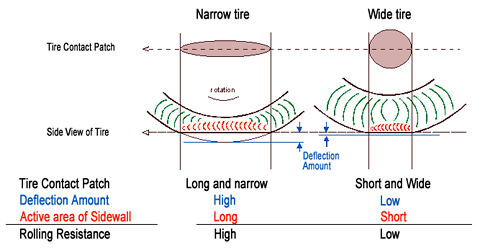
 By running the widest tires possible in your road bike you will gain a greater contact area for better handling, more air volume for greater pneumatic suspension and a wider footprint for conformity to road irregularities.  For what you pay in the marginal weight gain (around 100 grams or so between tube and tire difference for a 23c vs 32c width) and the extremely marginal aerodynamic drag that incurs (think less than 1% here) you will gain a more comfortable and stable ride.


the differences between narrow and wide tire contact patches


  If you are working with something like an older touring or mountain bike frame, even wider tires are highly encouraged depending again on load and terrain.  Supported findings have shown that dabbling beyond the 32c mark also shows marginal penalty for the added benefit.  Something around the 42mm (1.75") is a very healthy, happy medium for riding that entails some gravel, crush refine, hard pack dirt or heavily inconsistent pavement.

Catering to your needs


At the end of the day what it all really boils down to is you paying attention to the kind of riding you are doing (or want to do for that matter) and setting up your rig accordingly.  If you constantly find yourself riding on immaculately groomed pavement, width and tread is less of a concern as opposed to the varying terrain that composes much of suburbia and outer city fringes.  Having experimented with most tire sizes commonly available, from the extra thin to extra thick, i have found that the additional bit of width has enabled me to comfortably ride in a longer, more comfortable and versatile fashion with less hesitation and concern.  Ultra fat tires and super skinny tires both have their place, but the real question is figuring out what that means for you and your particular needs.